What Is a US Load Center? Inside a 16-Circuit 100A North American Distribution Panel
Introduction
For residential developments, prefab housing, light-commercial buildings, and compact OEM systems, the US load center is where incoming power is divided into protected branch circuits. It organizes breakers, line conductors, neutrals, equipment-grounding conductors, circuit identification, and future service access.
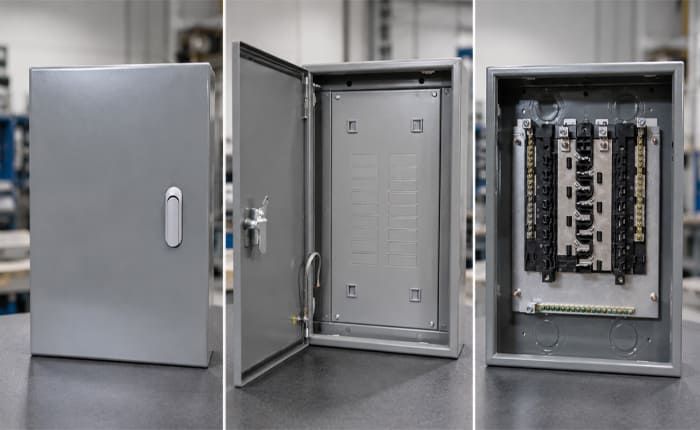
The reference product is described as a compact gray 100A load center with 16 numbered breaker positions, a hinged door, removable inner cover, multiple knockouts, neutral and grounding terminals, phase markings, labels, and a flexible door-bonding strap. It is therefore best presented as an indoor North American-style distribution assembly for residential, modular-building, light-commercial, or equipment-integration projects.
One accuracy point is essential: a cabinet that resembles a US panel is not automatically UL Listed, NEC compliant, or assigned a NEMA enclosure Type. The completed panelboard—including bus, breakers, terminals, enclosure, markings, and approved component combinations—must be evaluated and installed according to its certification and instructions. UL identifies UL 67 as the principal panelboard product standard, while the NEC governs installation.
What a US Load Center Actually Does
A load center is a compact branch-circuit distribution panel commonly used in homes and small buildings. It houses the bus structure, branch circuit breakers, wiring space, neutral terminals, grounding provisions, covers, and labels needed to distribute power to lighting, receptacles, HVAC equipment, appliances, pumps, and other downstream loads. Eaton describes load centers as enclosures specifically designed to house branch circuit breakers and the wiring required to distribute power to individual circuits.
Buyers may call the same product a breaker box, electrical panel, or North American electrical panel. “Panelboard” is the broader category; “load center” generally describes the compact residential and light-commercial form.
The product should be described as a 16-circuit load center rated up to 100 A according to its label. “16-circuit” is more natural in North America than “16-way.” Spaces and allowable circuits are not always identical, especially where tandem breakers are involved, so only breaker types and circuit counts identified on the product label may be used.
It also appears to be a main lug load center, because the description identifies incoming L1 and L2 lugs but no integral main breaker. A main-lug-only panel relies on upstream overcurrent protection and is commonly used as a downstream panel.
Reading the Product Structure from Outside In
The exterior uses a gray powder-coated steel box, hinged door, flush latch, rear mounting points, and knockouts on several surfaces. The latch reduces protrusion in apartment utility areas, prefab wall modules, and narrow service spaces.
Powder coating improves appearance and indoor handling durability, but it does not prove moisture resistance or a NEMA rating. NEMA enclosure Types describe specific environmental protection, so a Type claim should be used only when supported by product marking or certification.
The circular openings make the unit a practical knockout electrical box. Factory knockouts allow feeder and branch-circuit entry from different directions while reducing site drilling, metal debris, coating damage, and dimensional variation. Rear keyhole mounting can also speed positioning in repeated prefab or OEM installations.
For modular housing factories, this matters because the same back-box position and cable route may be repeated across dozens or hundreds of units. The more work completed accurately in the factory, the less cutting, alignment, and repair the site team must perform.
Why the Dead-Front and Circuit Directory Matter
Behind the outer door is the inner dead-front cover. Its job is to prevent normal access to energized bus parts while leaving breaker handles available for operation. North American panelboard design uses dead-front construction, and UL evaluates panelboard construction, markings, and intended component combinations as part of the complete product.
On the reference unit, the inner cover is numbered from 1 through 16. Numbering becomes useful only when it is coordinated with the circuit directory inside the door. NEC Article 408 includes circuit-directory requirements so that each circuit can be identified clearly and durably rather than with vague descriptions such as “lights” or “plugs.”
For an apartment, the directory may identify kitchen receptacles, lighting, HVAC, or dedicated appliances. For an OEM skid, it may identify pumps, heaters, service outlets, and auxiliary loads. Clear descriptions reduce diagnostic time and help future electricians understand the system.
| Visible Component | Primary Function | Why It Matters to the Buyer |
|---|
| Dead-front cover | Restricts access to internal energized parts while exposing breaker handles | Improves operating safety and creates a finished panel appearance |
| Numbered breaker positions | Links each breaker to the circuit directory | Speeds commissioning, inspection, and later troubleshooting |
| Multiple knockouts | Provides alternative conduit and cable-entry locations | Reduces field drilling and supports different installation routes |
| Neutral and grounding terminals | Terminates grounded and equipment-grounding conductors | Supports clearer wiring and correct service-versus-subpanel configuration |
| Door bonding strap | Maintains electrical continuity between movable metal parts | Provides a deliberate bonding path in this project-specific design |
Neutral, Ground, and Bonding: The Most Important Accuracy Correction
The photos reportedly show terminals marked N, a separate bar marked G, phase references for L1 and L2, and a flexible door bonding strap. These details are valuable, but their correct use depends on where the panel sits in the electrical system.
At service equipment, the grounded conductor and equipment-grounding system are bonded at the permitted service point. In a feeder-supplied downstream panel, the neutral is normally isolated from the metal cabinet, while equipment-grounding conductors terminate on a separate ground bar bonded to the enclosure. Eaton’s current load-center documentation states that in sub-feed applications the neutral must be isolated and grounding conductors terminated on a separate grounding bar.
The presence of a neutral bar and ground bar is therefore not enough by itself. The installer must know whether the panel is service equipment or a downstream panel, whether the neutral bonding means is installed or removed, and what the listing instructions require.
The braided door strap is best described as a project-specific bonding provision. It provides continuity for the movable metal door, but it is not proof that the complete panel is certified, and it should not be presented as a universal requirement for every load-center door.
This distinction is particularly important for prefab and OEM projects. If the enclosure is supplied without a clearly defined service or subpanel configuration, the site electrician may need to modify bonding hardware, replace bars, or clarify installation instructions before approval.
Which B2B Customers Buy This Product—and What Problems Are They Solving?
The most relevant buyers are not simply “B2B customers.” They are specific companies with different operational needs.
Prefab and modular-home manufacturers need a compact residential load center that can be mounted in repeatable wall or utility modules. Their priorities are consistent dimensions, predictable knockout locations, private labels, safe packaging, and minimal field modification.
Residential developers, general contractors, and MEP contractors need panels that arrive on schedule, fit approved wall openings, and can be wired without delaying plastering, painting, or final handover. Their main risks are dimensional changes, missing accessories, unclear certifications, and inspection failure.
Electrical contractors and panel builders need a circuit breaker panel with usable wire-bending space, logical terminals, accurate labels, compatible breakers, and straightforward service access. They value speed, but they also need documentation that clearly identifies what the panel is approved to do.
Electrical distributors and private-label brands need repeatable models, packaging, catalog data, replacement parts, and market-specific certification. Their after-sales risk rises when products use unclear breaker combinations or unsupported compliance claims.
OEM equipment manufacturers may integrate the panel into HVAC skids, pumps, mobile buildings, charging equipment, laboratories, or packaged utility systems. They often need customized mounting, feeder entry, warning labels, or a compact electrical distribution box that fits a larger machine assembly.
For all these buyers, the value is reduced field work and uncertainty—not merely a lower-cost steel cabinet.
How to Specify a 16-Circuit 100A Load Center Correctly
A buyer should never place an order using only “16-way, 100A box.” A technically useful specification should state:
- System voltage, frequency, and phase
- Maximum bus rating
- Main-breaker or main-lug configuration
- Number of spaces and permitted circuits
- Approved circuit-breaker family
- Short-circuit current rating
- Indoor or outdoor installation
- Surface- or flush-mount structure
- Feeder conductor range
- Neutral and grounding arrangement
- Required enclosure Type
- Labeling and documentation
- Target certification pathway
The distinction between a complete listed panel and a custom panelboard enclosure is especially important. UL 67 evaluates complete panelboards and their construction, markings, and intended use. A fabricated box, dead-front, and terminal arrangement may be an excellent manufacturing platform, but the finished product should not be marketed as “UL Listed” unless the complete configuration is covered by the applicable certification.
Breaker compatibility must also follow the panel labeling and approved combinations, not physical fit alone. UL guidance emphasizes using equipment in accordance with its certification, markings, and instructions.
A reliable manufacturer should therefore supply drawings, labels, component schedules, conductor ranges, torque information, and certification records before the panel reaches the jobsite.
How E-abel Manufactures and Customizes the Load Center Platform
E-abel manufactures electrical enclosures and offers custom design, component integration, assembly, and project support for factories, contractors, wholesalers, distributors, panel builders, and equipment manufacturers. Its published capabilities include custom dimensions and cutouts, sheet-metal production, enclosure assembly, component sourcing, and batch manufacturing.
For an E-abel load center project, customization can cover:
- Enclosure dimensions and steel thickness
- Powder-coating color and surface finish
- Door, hinge, and latch design
- Knockout diameter and position
- Surface- or flush-mount geometry
- Dead-front openings and breaker layout
- Circuit directories and technical labels
- Grounding studs and bonding hardware
- Neutral and ground-bar positions
- Rear mounting-hole pattern
- Private branding and packaging
Engineering should begin with the single-line diagram, voltage and phase, feeder current, main-lug or main-breaker requirement, breaker family, circuit count, cable-entry direction, mounting method, short-circuit rating target, and certification pathway.
E-abel can standardize wall modules for prefab housing, support private labels for distributors, adapt back boxes for OEM machinery, and supply a project-ready custom electrical enclosure platform for contractors.
The responsible commercial message is not “this enclosure automatically meets every US requirement.” It is that E-abel can manufacture a North American-style load-center platform around the customer’s drawings and target certification, while the final rating, listing, breaker combinations, and installation conditions must be confirmed for the completed product.
Conclusion
The reference product is best described as a compact indoor US load center with a 16-position, 100 A configuration shown on its label, multiple knockouts, a dead-front cover, circuit directory, neutral and grounding terminals, phase markings, and a deliberate door-bonding connection.
Its value comes from the interaction of those details: knockouts reduce drilling, the dead-front limits access to energized parts, numbered positions improve identification, and separate neutral and grounding provisions support correct feeder-panel wiring.
The key buying lesson is simple: appearance is not certification. Buyers must verify the complete assembly’s listing, breaker compatibility, short-circuit rating, enclosure Type, neutral-ground configuration, and intended application.
E-abel can customize this platform for prefab builders, contractors, panel shops, distributors, and OEM equipment manufacturers. Planning the enclosure, internal arrangement, labels, and certification pathway together creates a safer and more serviceable North American distribution solution.
Keywords:
US load center, 100A load center, 16-circuit load center, residential load center, North American electrical panel, circuit breaker panel, panelboard enclosure, electrical distribution box, indoor electrical enclosure, main lug load center, neutral bar, ground bar, knockout electrical box, dead-front cover, E-abel load center