Why UL 891 Switchgear Costs More Up Front—but Saves More Over Time
Introduction
When a power-distribution buyer first compares a UL 891 switchboard with a lower-cost cabinet built around non-U.S. practices, the price difference can feel hard to justify. On a spreadsheet, one option simply looks more expensive.
That is usually where the wrong conclusion begins.
A US low-voltage distribution project is not judged only by purchase price. It is judged by whether the switchboard fits the local safety framework, whether the equipment can be installed and maintained with confidence, and whether the system will still perform reliably years after commissioning. UL 891 is the UL standard for dead-front switchboards, and UL explains that the standard is broadly recognized and applied in North America. UL also notes that, in this context, a switchboard means a dead-front assembly with no exposed live parts on the front.
That difference matters in real projects.
One contractor working on a US industrial facility initially wanted the lowest first-cost solution. The logic seemed reasonable: use a simpler cabinet, reduce material cost, and keep the bid competitive. But once the design moved closer to execution, the hidden conflicts appeared. Component acceptance became more sensitive. Space planning became tighter. Thermal and layout concerns became harder to ignore. What looked cheaper on day one started to look riskier over the full life of the project.
This is why UL891 switchgear should be understood as a value decision, not just a cost decision.
For industrial and commercial customers, the real question is not “Why is UL 891 more expensive?” The better question is “What exactly are we paying for, and where does that value come back?” This article answers that question by looking at material choices, insulation strategy, enclosure design, component certification, density, and lifecycle logic—and by showing how E-abel electrical solutions help customers build distribution systems that are safer, more durable, and better aligned with US expectations.
The Industry Pain Point: Cheap Switchboards Often Become Expensive Systems
In many electrical projects, buyers are under pressure to control budget early. That is understandable. But low-voltage switchboards are rarely isolated purchases. They sit at the center of the building’s power-distribution strategy, so mistakes in the switchboard affect maintenance, safety, panel count, installation labor, and future modifications.
This is where the pain point becomes real.
A low-cost assembly may reduce the purchase line item, yet still create long-term cost through higher installation complexity, lower acceptance confidence, less predictable thermal performance, or more difficult service access. By contrast, a properly built dead-front switchboard under the UL 891 framework is intended to be installed in accordance with the NEC and its certification, which is one reason US buyers treat it as a system-level decision rather than a generic cabinet choice.
The project conflict is therefore not simply cost versus quality. It is upfront cost versus full-lifecycle risk.
That is why customers evaluating US electrical standards need to understand where UL 891 adds cost, where it removes cost, and where it prevents much larger expenses later.
Why UL 891 Switchgear Costs More
The premium attached to UL 891 switchgear is not arbitrary. It comes from design discipline.
First, the product category itself is more demanding than a basic enclosure with breakers installed inside it. UL explains that UL 891 covers dead-front switchboards and that these assemblies are intended to meet the applicable North American installation expectations. That means product design, component selection, construction logic, and certification pathway all have to align.
Second, component discipline increases cost. UL’s switchboard guidance emphasizes the importance of correct design parameters and the use of appropriate listed or recognized components under the UL 891 framework. That is important for the buyer because internal parts are not chosen only by convenience or price; they must support the compliance path of the finished switchboard.
Third, insulation strategy matters. In many North American switchboard discussions, GPO-3 insulation is valued because it offers strong flame resistance and tracking performance for electrical applications. Public GPO-3 technical datasheets commonly show UL 94 V-0 flammability and CTI 500 V-class performance, which helps explain why the material is widely used for electrical insulation structures such as bus supports, barriers, and mounting parts.
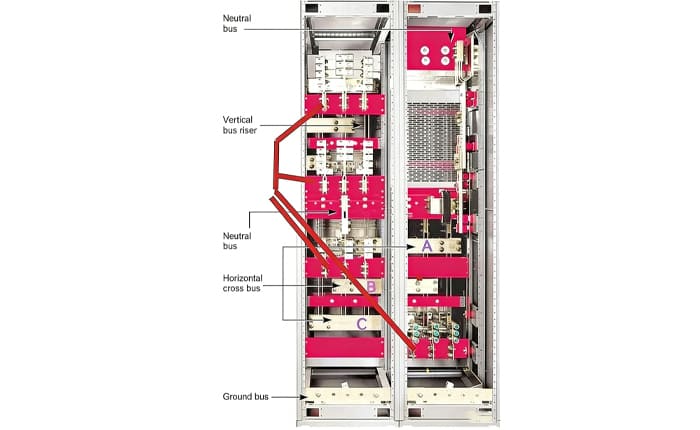
Fourth, enclosure execution matters. A proper high-density electrical panel has to balance conductor routing, breaker placement, heat behavior, working access, and service logic in a much tighter, more disciplined way than a loosely arranged cabinet. That level of planning is part of the cost, but it is also part of the value.
The Project Conflict: “Premium” Materials vs “Affordable” Design Logic
This is where the buyer conversation becomes more interesting.
A UL 891 switchboard may use more expensive construction logic in some areas, yet still save money in others. That is because North American switchboard design is not about adding cost everywhere. It is about placing cost where it matters most and removing it where it does not.
For example, many buyers assume that a more robust switchboard must automatically be larger, heavier, and more complicated. In reality, UL891 switchgear often gains value from better density and more direct construction logic. A smarter arrangement of bus, devices, cable terminations, and operating fronts can reduce the total number of enclosures required for the same distribution scope. When that happens, the product may cost more per unit but less per function.
That is why the right comparison is not panel-to-panel. It is system-to-system.
Where UL 891 Saves Money
One of the most overlooked benefits of UL 891 switchgear is that it can reduce cost by simplifying the right parts of the design.
A good example is enclosure type. For many indoor applications, NEMA 1 protection is often enough. NEMA Type 1 is intended for indoor use and primarily protects people from access to hazardous parts and helps protect the equipment inside from falling dirt. Because it is not an outdoor washdown or corrosion-rated Type, it avoids the cost of higher environmental protection where that protection is unnecessary. NEMA also makes clear that IP codes and NEMA Types are not directly interchangeable one-for-one, and that IP ratings are not a substitute for enclosure Type ratings in U.S. installations.
That point matters because many buyers compare indoor North American switchboards to higher-ingress IEC-style cabinets without asking whether the extra enclosure complexity is actually required.
Another area of savings is layout efficiency. A well-designed high-density electrical panel can consolidate more distribution capacity into fewer sections. That reduces floor space, shipping volume, and installation time. It can also reduce the total number of field terminations and simplify coordination between upstream and downstream equipment.
A third area is incoming-section simplification. In some project strategies, the switchboard can be configured so that not every section has to be burdened with unnecessary complexity. When the design is matched correctly to the application, cost comes down through smarter structure rather than through weaker structure.
GPO-3 Insulation: Why This Cost Driver Often Protects Long-Term Value
For customers unfamiliar with North American switchboard materials, GPO-3 insulation can look like an expensive detail. In reality, it often represents one of the more rational investments inside the assembly.
GPO-3 is widely used as an electrical insulation material because it combines mechanical strength with dielectric performance and flame resistance. Public technical data commonly identify it as a fiberglass-reinforced thermoset polyester laminate used for electrical barriers, bus supports, spacers, and switchgear-related insulation parts. Typical data also show UL 94 V-0 behavior and strong comparative tracking performance.
That matters because switchboards are not only about carrying current. They are about managing clearances, supporting conductors mechanically, controlling arc- and track-related risks, and maintaining dependable insulation behavior over time. Buyers may not see that value from the outside, but they benefit from it every day the system remains stable.
NEMA 1 vs IP: A Quick Buyer Education Section
Because this topic often causes confusion, it is worth clarifying one important point.
A NEMA 1 protection enclosure is not simply “IP10 in another name.” NEMA’s own enclosure-type comparison guidance states that IP codes cannot be converted directly into enclosure Type numbers, and that some NEMA Types include broader test expectations than IEC ingress ratings alone. In other words, the systems overlap in purpose but differ in structure and scope.
For buyers, the practical takeaway is simple:
| System | Main Focus | Useful Buyer Reminder |
|---|
| NEMA Type | Environmental use context in North American enclosure practice | Can include broader conditions than ingress alone, depending on the Type |
| IP Code | Dust and water ingress protection under IEC 60529 | Helpful for global comparison, but not a direct substitute for NEMA Type in U.S. projects |
This is one reason why US switchgear decisions should be made within the right standards framework rather than by rough equivalence.
E-abel Also Produces This Type of Product
For many customers, the most important question is not theoretical. It is practical: can the supplier actually support this kind of solution?
Yes. E-abel electrical solutions include custom electrical enclosure and power-distribution products for North American-oriented projects, including low voltage switchboard solutions aligned with the UL 891 category and the design logic that category requires. That means E-abel is not only discussing the cost-value theory of UL891 switchgear. E-abel can also support the manufacturing side of this product type for customers who need project-based distribution equipment.
This matters because the real value of a switchboard is not just in the drawing set. It is in the ability to turn standards-aligned design into a manufacturable, installable, and serviceable product.
Conclusion
The question is not whether UL 891 switchgear costs more. In many cases, it does.
The more important question is why that cost exists and what it buys. It buys a dead-front switchboard framework recognized in North America, better alignment with U.S. installation logic, disciplined use of certified components, stronger insulation strategy through materials like GPO-3 insulation, and the possibility of more efficient high-density system design. At the same time, it can reduce total ownership cost by avoiding overbuilt enclosure features where they are not needed, simplifying the right sections of the design, and reducing the number of panels required for the same distribution function.
For industrial and commercial customers, that is why UL891 switchgear is better understood as a long-term value product, not simply a premium-cost product.
Keywords:
UL891 switchgear, electrical enclosure, GPO-3 insulation, NEMA 1 protection, high-density electrical panel, North American electrical standards, E-abel electrical solutions, low voltage switchboard, dead-front switchboard, UL 891 switchboard, industrial power distribution, custom electrical enclosure, power distribution cabinet, commercial electrical panel, North American switchgear