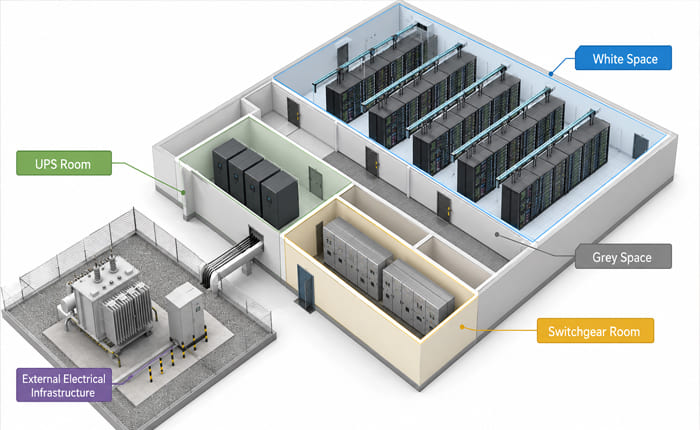
Why UPS and Switchgear Should Not Be Forced Into One Compact Lineup
Introduction
Data centers are built on one promise: keep digital infrastructure running without interruption. Behind that promise is a complex power chain that includes utility feeds, standby generators, transformers, medium voltage switchgear, low voltage switchgear, UPS systems, batteries, PDUs, busways, and thousands of electrical connection points.
In recent years, many data center projects have moved toward compact, prefabricated, and modular power rooms. The idea sounds attractive. Put switchgear, UPS cabinets, batteries, monitoring devices, and cooling equipment into one compact data center power module. Save space. Shorten deployment time. Reduce field installation work.
But in mission-critical electrical systems, compact does not automatically mean safer.
A modular power cabinet still has to respect basic engineering realities: heat dissipation, arc-flash risk, fault isolation, cable bending space, service clearance, fire separation, and long-term maintenance access. Uptime Institute’s 2024 outage research notes that power issues remain a consistent cause of serious and severe data center outages, even as network-related events also create major disruption.
So the real question is not, “How small can we make the power module?” The better question is, “How can we design a data center power distribution system that is compact, safe, maintainable, and energy-efficient at the same time?”
Hidden Risk One: UPS Heat and Switchgear Heat Are Not the Same
A common design mistake in compact power modules is placing UPS cabinets directly beside low voltage switchgear as if both systems behave the same thermally. They do not.
A switchgear lineup generates heat mainly from busbars, breakers, contact resistance, cable terminations, metering devices, and internal wiring. Under normal design conditions, this heat can be managed through proper conductor sizing, ventilation, spacing, and tested temperature-rise performance.
A UPS system is different. A high-capacity UPS includes rectifiers, inverters, filters, capacitors, fans, control electronics, and sometimes nearby battery systems. These components generate heat continuously during power conversion. If a large UPS is installed directly beside switchgear inside the same compact electrical module, the UPS heat can raise the surrounding cabinet temperature.
That creates a hidden chain reaction. Higher ambient temperature around switchgear may accelerate insulation aging, increase breaker stress, reduce component life, and make maintenance less predictable. Cooling may also become less efficient. NREL research notes that data center cooling-related loads can account for as much as 40% of total energy consumption in some facilities, which means poor electrical-room heat planning can quietly increase operating cost.
This is why many North American and international data center designs separate UPS rooms, battery rooms, and data center electrical room switchgear areas by function. The goal is not to make the system larger for no reason. The goal is to give each power function the environment it needs.
Why Separating UPS, Batteries, and Switchgear Often Makes More Sense
A compact system can still be modular without forcing all equipment into one narrow lineup. Good modularity means repeatable engineering, standardized interfaces, factory-built quality, and safe functional separation.
A safer data center power design often divides the system into dedicated spaces. UPS cabinets are placed in a UPS room or power block. Battery systems are placed in a battery room or fire-rated energy storage area. Low voltage switchgear and medium voltage switchgear are installed in electrical rooms with proper working clearance, ventilation, cable access, and service pathways.
This separation improves three things.
First, it improves thermal control. UPS equipment can receive cooling designed for high heat density, while switchgear stays in a more stable electrical-room environment.
Second, it improves fault isolation. If a UPS fails, it is less likely to damage the switchgear lineup. If a switchgear fault occurs, it is less likely to directly impact batteries or UPS modules beside it.
Third, it improves maintenance. Technicians can inspect switchgear, test UPS modules, and service battery systems without working in an overloaded or crowded electrical zone.
For battery energy storage and stationary battery systems, NFPA 855 is commonly referenced because it provides minimum requirements for mitigating hazards associated with stationary energy storage systems. This reinforces a simple engineering principle: energy storage is not just another cabinet. It requires its own risk planning.
Internal Arc Faults: The Risk Compact Layout Cannot Ignore
An internal arc fault inside switchgear is one of the most severe events that can happen in an electrical room. It can produce intense heat, pressure, molten metal, toxic gases, and a mechanical shock wave. The danger is not only the electrical fault itself. The danger also depends on how the switchgear enclosure contains, redirects, or releases that fault energy.
IEEE C37.20.7 covers procedures for testing and evaluating metal-enclosed switchgear under internal arcing fault conditions, including how equipment capabilities are identified and applied. This is why IEEE C37.20.7 is important when discussing arc-resistant switchgear.
When arc-resistant gear is properly designed, the cabinet structure, doors, vents, pressure-relief channels, and compartments are engineered to reduce danger to personnel and nearby equipment. But when switchgear is squeezed beside UPS cabinets or batteries, the risk becomes more complicated.
If an internal arc event deforms a switchgear section, adjacent UPS equipment may be damaged. If a battery or UPS fire spreads into nearby switchgear, the whole power path may be interrupted. What started as one equipment fault can become a complete module failure.
For data center owners, EPC contractors, colocation operators, and electrical consultants, the lesson is clear: fault isolation is part of uptime strategy. A data center power module may look efficient in a layout drawing, but it becomes fragile if one internal fault can damage every critical component in the same lineup.
High-Density Cabinets Create Cable, Heat, and Maintenance Problems
Another hidden risk is installation density.
To reduce footprint, some compact modules limit cabinet depth and working space. However, high-current switchgear often needs enough depth for busbars, breakers, cable bending radius, rear cable compartments, heat dissipation, and safe maintenance access.
A 5000A or 6000A incoming section may include large copper busbars, power circuit breakers, current transformers, metering devices, control wiring, and high-current cable terminations. If multiple large breakers are installed in one compact section, the number of copper joints increases, the thermal load becomes concentrated, and service access becomes harder.
The nameplate rating alone is not enough. Engineers need to ask practical questions:
Can technicians inspect busbar joints? Is there enough space around power conductors? Can cable lugs be torque-checked safely? Are cable bends acceptable? Are power wiring and communication wiring separated? Can heat leave the cabinet without creating a trapped hot zone?
Fans may move air, but they cannot fix poor conductor spacing, inaccessible cable compartments, overloaded connections, or a cabinet design that traps heat. In a mission-critical power distribution enclosure, physical layout is not a detail. It is part of reliability.
Monitoring Improves Visibility, but It Also Adds Complexity
Modern data centers need intelligent monitoring. Operators want to see load current, breaker status, temperature, alarms, energy use, and power quality. That is reasonable. Without visibility, teams cannot manage capacity or detect risk early.
However, every monitoring device adds wiring, CTs, sensors, communication ports, auxiliary power, terminals, and configuration points. If every circuit is overloaded with devices, the cabinet becomes crowded and harder to maintain.
The best design is not “install more meters everywhere.” The best design is selective and maintainable.
Critical incomers, bus sections, UPS feeders, and major distribution paths should receive detailed monitoring. Non-critical branches may use simpler monitoring. All communication wiring should be separated from power wiring. Labels must be clear. Devices must be accessible. Terminal blocks should not be buried behind high-current conductors.
This is where the electrical enclosure becomes more than a metal box. It becomes a reliability platform. A good enclosure supports safe spacing, clean wiring ducts, cable glands, grounding, bonding, communication separation, ventilation, and future inspection.
Better Functional Zoning for Data Center Electrical Rooms
For North American and international projects, a more mature approach is functional zoning. Instead of forcing UPS, batteries, and switchgear into one compact lineup, the facility separates the major power functions and connects them through engineered pathways.
| Functional Area | Main Equipment | Design Priority | Why Separation Helps |
|---|
| Switchgear Room | Medium voltage switchgear, low voltage switchgear, main breakers, busbars | Arc safety, heat dissipation, access clearance | Reduces exposure to UPS heat and battery fire risk |
| UPS Room | UPS cabinets, bypass cabinets, power conversion modules | Thermal management and service continuity | Cooling can be designed around UPS heat load |
| Battery / ESS Room | Battery racks, BMS, protection devices, DC distribution | Fire separation, ventilation, fault containment | Limits the impact of battery failure on UPS and switchgear |
| White Space | Server racks, rack PDUs, busways, IT loads | Stable power delivery and airflow | Keeps IT equipment away from heavy electrical fault zones |
This zoning strategy does not reject modular design. It makes modular design safer. Each area can be designed, cooled, maintained, and upgraded according to its own risk profile.
E-abel Knowledge: What B2B Buyers Should Look for in Data Center Electrical Enclosures
For data center power projects, E-abel recommends evaluating the cabinet structure as part of the complete electrical system—not as a separate enclosure purchased at the end.
A good data center electrical room cabinet should support strong mechanical construction, high-current component mounting, proper cable compartments, grounding and bonding, ventilation, monitoring cutouts, removable panels, and safe maintenance access.
For UL 1558 switchgear, low voltage switchgear, UPS auxiliary cabinets, PDU cabinets, battery interface cabinets, and outdoor power cabinets, E-abel can customize enclosure dimensions, cabinet depth, mounting plates, cable entry, busbar space, ventilation, door locks, meter windows, HMI cutouts, gasket structure, and internal separation.
The value is not only customization. The value is engineering alignment.
If the project needs compact installation, E-abel can help optimize cabinet width, depth, cooling path, bottom cable entry, rear access, and modular assembly. If the project needs safer separation, E-abel can design independent enclosures for different power functions. If the project is for the North American market, cabinet design can be prepared around NEC-based installation logic, UL-oriented expectations, NEMA-style protection needs, and practical service access.
A safe E-abel custom enclosure should never sacrifice heat dissipation, arc safety, cable space, or maintainability just to appear smaller.
A Better Direction: Functional Modularity, Not Blind Miniaturization
The future of data center power design is not to reject modular power systems. Factory-built modules, prefabricated electrical rooms, skid-mounted distribution systems, and containerized power blocks can all be excellent solutions when designed correctly.
The better direction is functional modularity.
Keep UPS heat away from switchgear. Keep battery risk separated from main distribution. Keep medium voltage switchgear in professionally managed electrical zones. Keep cable compartments large enough for real installation work. Keep monitoring useful but not excessive. Keep maintenance access simple enough for technicians to work safely under pressure.
This approach reduces hidden risk while still supporting fast deployment, repeatable manufacturing, scalable expansion, and improved energy planning.
For B2B customers, this means the best modular power cabinet is not always the smallest one. It is the one that allows the electrical system to remain safe, maintainable, and reliable for years of operation.
Conclusion
A compact data center power module can look efficient on paper, but if low voltage switchgear, UPS systems, batteries, and monitoring devices are forced into one dense lineup, the risks can become serious.
UPS heat can raise switchgear temperature. Internal arc faults can damage adjacent equipment. Battery failures can spread into distribution systems. Overly tight cabinet depth can create thermal concentration, cable stress, difficult maintenance, and hidden connection risks.
For English-speaking and North American data center buyers, a better strategy is to separate functions, connect them safely, and design every electrical enclosure around its real operating environment. Standards and guidance such as IEEE C37.20.7, NFPA 855, and data center outage research all point toward one principle: electrical reliability depends on tested design, correct installation, realistic risk control, and serviceable cabinet architecture.
E-abel helps B2B customers turn this principle into practical enclosure solutions, including custom switchgear enclosure designs, UPS auxiliary cabinets, power distribution enclosure solutions, and data center electrical room cabinet systems.
Keywords:
data center power module, low voltage switchgear, medium voltage switchgear, UPS system, electrical enclosure, switchgear enclosure, data center electrical room, arc-resistant switchgear, data center power distribution, UPS battery fire risk, modular power cabinet, power distribution enclosure, UL 1558 switchgear, IEEE C37.20.7, E-abel custom enclosure