UL 891 Switchboards + Compact Medium-Voltage Lineups: A Project-Style Power Distribution Story for Modern Data Centers
Introduction
Data centers don’t fail slowly—they fail suddenly. One overheated section, one maintenance error, or one layout decision that looked “fine on paper” can ripple into downtime, SLA penalties, and reputational damage. That’s why power distribution in a data center is never just about amperage; it’s about density, serviceability, and compliance working together inside a reliable electrical enclosure system.
where the owner needed high-density low-voltage distribution plus a compact medium-voltage incoming lineup, all inside space-constrained rooms and prefab modules. We’ll explain what drove the equipment choices (including UL 891 switchboard layouts), how separation and thermal planning reduced risk, and why E-abel’s enclosure engineering mattered to the final outcome.
Project Snapshot
A data center developer was scaling capacity fast, using a mix of traditional electrical rooms and prefabricated modules. Their priorities were familiar:
- Fit more power distribution into less floor space
- Keep maintenance front-access where possible
- Avoid thermal conflicts between heat-generating equipment
- Make compliance straightforward for AHJ review and commissioning
- Standardize enclosures and mounting so future pods can repeat the design
This is where data center power distribution becomes a systems problem—not a single product decision.
Challenge: High Density, Tight Space, and “Standards Stacking”
1) Density without creating maintenance bottlenecks
The project needed low-voltage distribution with high feeder count and high redundancy—without expanding the electrical room footprint. In prefab builds, every inch affects transport, lifting, and aisle clearance.
2) Thermal separation between power blocks
Not all equipment behaves the same thermally. Some blocks (battery/UPS systems, power electronics) can be major heat sources. If you pack everything together, you risk temperature-rise issues and derating—especially when enclosures are installed in compact pods.
3) Compliance complexity (the part that slows projects)
A common trap is mixing terms and standards incorrectly. For example:
- UL 891 switchboard: low-voltage switchboards (distribution assemblies)
- Battery energy storage safety often involves UL battery standards and test methods (e.g., UL 1973 for batteries; UL 9540 system-level; UL 9540A as a fire propagation test method used to evaluate thermal runaway behavior)
- UPS equipment is typically evaluated to its own product standard (commonly UL 1778 in North America, depending on system type)
If a project team treats these as “one standard,” approvals get messy fast. The buyer wanted a layout and enclosure plan that reduced interpretation risk.
4) MV lineup footprint in a pod environment
On the medium-voltage side, classic switchgear can be physically large and may require rear access. In a prefab module, rear-access is often a deal-breaker.
Solution: A Two-Layer Architecture (LV UL 891 + Compact MV) Built Around Enclosure Strategy
Step 1 — Start with a clean one-line and physical block layout
The team designed a repeatable architecture:
- MV incoming lineup (compact front-access where possible)
- Transformer interface
- LV distribution using low voltage switchgear / switchboard assemblies
- Separate zones for high-heat power electronics (where applicable)
- Clear cable routing and service aisles
This is where enclosure decisions directly affect uptime: the physical lineup must support maintenance without forcing risky work positions.
Why UL 891 Switchboards Were the LV Backbone
In this project, UL 891 switchboard assemblies were used as the primary LV distribution approach because they offered high density and a practical service model for data centers.
1) Dead-front safety that simplifies operation
A dead-front switchboard design keeps live parts behind protective barriers so operators interact with handles, metering, and breaker interfaces without exposing energized conductors. In data centers—where work happens under time pressure—this reduces human-error exposure.
2) Serviceability with draw-out where it matters
For critical feeders, a draw-out circuit breaker strategy can reduce downtime during replacement and testing (depending on breaker frame and lineup design). The project used a mix of fixed and draw-out positions to balance cost and maintenance speed.
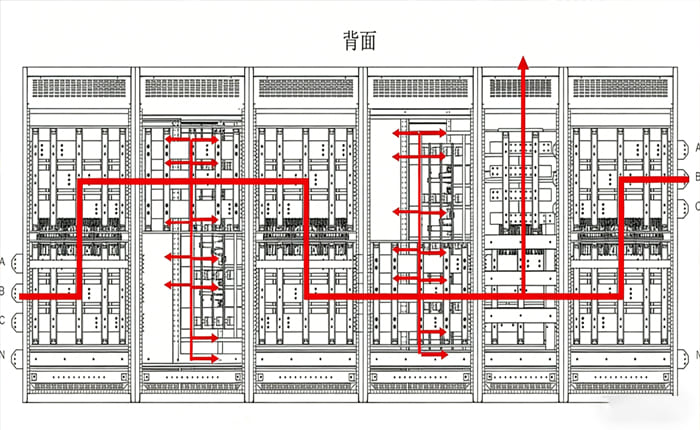
3) Busbar layout optimized for density and cabling
The lineup adopted a rear-mounted busbar approach to keep the front area cleaner for devices and maintenance. Rear busbar placement can also support more predictable cable routing and compartment organization in high-density builds.
4) Short-circuit performance planning
Data centers often demand robust fault withstand because of transformer sizes and parallel sources. The design team treated short-circuit rating as an early constraint, not a checkbox at the end, to avoid redesign later
Medium-Voltage Strategy: Compact Where Space Drives the Decision
On the MV side, the project evaluated traditional and compact approaches. In space-limited builds, rear-access gear and deep lineups create installation friction.
- Traditional metal-clad designs aligned with IEEE C37.20.2 can be physically substantial and may require more clearance.
- Compact solutions—often including gas-insulated designs aligned with IEEE C37.20.9—can reduce footprint and simplify front-access cabling, depending on project requirements and utility interface.
The key point for the buyer wasn’t “one technology is always best.” It was: choose the MV lineup that fits the room and service model without compromising safety, access, and documentation.
The Enclosure Strategy That Made the Layout Repeatable
This is where E-abel entered the conversation. The owner didn’t only need equipment—they needed an enclosure and lineup platform that could be repeated across pods and future expansions.
What E-abel contributed (without slowing procurement)
E-abel focused on the “container” that makes the electrical system buildable:
- electrical enclosure engineering for LV and MV lineup integration
- Panel and door structures designed around front-access maintenance
- Cable entry planning (top/bottom/side) coordinated with busbar and device locations
- thermal management provisions: ventilation zoning, plenum planning, and space for cooling where required
- Structural design aligned with lifting, transport, and installation constraints for a prefabricated data center pod
In other words, E-abel helped convert a one-line diagram into a manufacturable physical system.
A Quick Standards Map (So Teams Stop Losing Time)
Below is a practical “who governs what” reference the project used during review.
| Category | Typical Standard / Reference | Why It Matters in Data Centers |
|---|
| LV switchboards | UL 891 switchboard | Defines construction and safety expectations for switchboard assemblies used in LV distribution. |
| MV metal-clad switchgear | IEEE C37.20.2 | Common reference for metal-clad MV designs; affects footprint, access, and lineup construction. |
| Compact / GIS MV gear | IEEE C37.20.9 | Often associated with compact, enclosed MV approaches that help when space is constrained. |
| Electrical installation rules | NEC compliance | Influences wiring methods, grounding/bonding, working clearances, and field acceptance. |
Results: What Improved After the Design Was Locked
When the project shifted from “equipment list” thinking to “layout + enclosure platform” thinking, three outcomes became clear:
1) Faster deployment across repeated builds
Once the enclosure dimensions, cable paths, and access model were standardized, the team could replicate the architecture across multiple modules. That’s the quiet win in modern builds: repeatability.
2) Lower maintenance friction
Front-access planning plus clearer internal zoning reduced technician time during inspection and replacement events. In a 24/7 facility, ease of service is real money.
3) Fewer late-stage redesign surprises
By treating compliance and heat zoning early—especially around mixed equipment rooms—the project avoided common late-stage problems like aisle conflicts, clearance issues, and derating concerns.
Selection Reasons: Why the Buyer Chose This Approach
The buyer didn’t choose “UL 891” because it sounded good. They chose it because it aligned with their operational reality. Their decision logic looked like this:
- Density: maximize branch distribution in limited footprint
- Service model: reduce exposure and speed up work using dead-front and selective draw-out
- MV footprint: use compact MV lineup approaches when pods demand it
- Documentation clarity: reduce standards confusion early
- Buildability: ensure enclosure design supports real installation, not just drawings
That last one—buildability—is where E-abel’s enclosure engineering had the most leverage.
E-abel Also Manufactures the Enclosure Platform for This System
E-abel is not only a “design advisor.” E-abel manufactures the physical enclosure platform that makes these systems deployable for critical facilities, including:
- LV switchboard lineup enclosures and compartment structures (integrating approved components per project BOM)
- MV lineup housings and supporting enclosure structures where required by the system design
- prefabricated data center pod electrical-room enclosure solutions (integrated ventilation zones, access doors, mounting rails, cable entry planning)
- Custom mechanical layouts that preserve service clearances and thermal planning goals
If your team is trying to scale data center builds, that manufacturing capability matters: it means your next site doesn’t start from zero.
Conclusion
Modern data centers demand power systems that are dense, serviceable, and predictable. In this project story, the winning approach was:
- LV distribution anchored by UL 891 switchboard assemblies for high-density, dead-front safety
- MV incoming strategy chosen for footprint and access, referencing IEEE C37.20.2 and compact options aligned with IEEE C37.20.9
- A manufacturing-first enclosure platform from E-abel, enabling repeatable builds, cleaner thermal zoning, and smoother field installation
When power distribution is designed as a system—not a shopping list—the results show up in commissioning speed, uptime confidence, and easier expansion.
Keywords:
UL 891 switchboard, Data Center Power Distribution, medium voltage switchgear, low voltage switchgear, electrical enclosure, prefabricated data center pod, draw-out circuit breaker, dead-front switchboard, rear-mounted busbar, short-circuit rating, IEEE C37.20.2, IEEE C37.20.9, NEC compliance, thermal management, E-abel