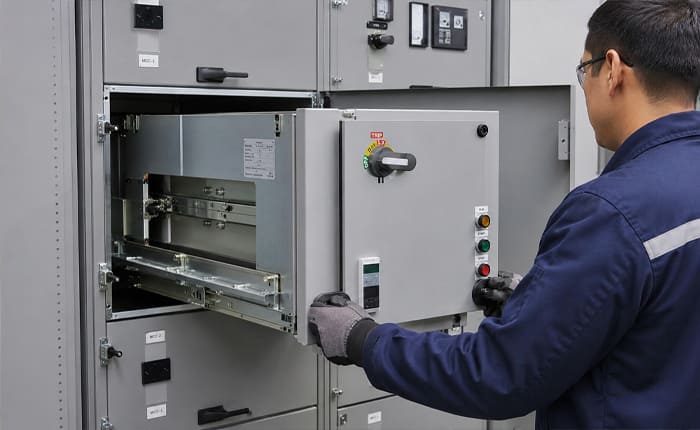
UL 845 Low Voltage MCC: A Reliable North American Motor Control Solution for Industrial Projects
Introduction
In a modern industrial plant, motor control is not just about starting and stopping equipment. It affects production uptime, worker safety, maintenance speed, power distribution stability, and long-term operating cost.
For factories, water treatment plants, mining sites, food processing lines, HVAC systems, and automation facilities, motors often sit at the center of daily operation. Pumps move water. Fans control airflow. Conveyors move materials. Compressors support production. If the motor control system fails, the entire process can stop.
This is why a low voltage MCC must be designed as more than a cabinet full of starters. For the North American market, the assembly must follow strict safety expectations, including UL 845, NEMA construction practices, proper busbar protection, reliable plug-in units, and safer maintenance features.
E-abel’s North American standard NEMA motor control center is engineered for projects that require compliant motor control, high-density layouts, front-access maintenance, flexible feeder and starter configurations, and optional arc flash mitigation features. It is built for B2B customers who need an MCC that is practical for installation, reliable for operation, and easier for technicians to maintain over the equipment lifecycle.
The Real Challenge: Motor Control in North American Projects
Many industrial customers face the same problem when selecting motor control equipment for North America: a cabinet that works electrically in one market may not automatically satisfy North American inspection, wiring, spacing, short-circuit, or safety expectations.
A project may need to control dozens of motors with different operating profiles. Some motors require full-voltage non-reversing starters. Others need reversing starters, soft starters, or VFDs. Some loads require future expansion. Maintenance teams may need to remove starter units quickly without shutting down an entire lineup.
At the same time, North American electrical projects often require clear documentation, tested assemblies, recognized components, safe working clearances, and appropriate enclosure types.
This is where a UL 845 MCC provides value. UL 845 is the standard specifically written for motor control centers, not a general control panel standard. It covers the MCC assembly as a complete product category, helping customers avoid the common mistake of assuming that UL components alone make the whole MCC compliant.
For B2B customers, the difference is practical. A properly engineered MCC reduces inspection risk, improves uptime, protects technicians, and makes future service easier.
UL 845 Compliance: Why It Matters
For North American motor control projects, compliance is not a marketing label. It is a project requirement.
A UL 845 listed MCC is evaluated as a motor control center assembly, including structural design, bus systems, wiring, spacing, protection, short-circuit performance, and internal units. This makes it more appropriate for MCC applications than relying only on individually certified components.
E-abel designs its MCC solutions around this whole-assembly logic. That means the electrical enclosure, internal busbar system, plug-in units, terminal areas, wiring method, grounding structure, and protection devices must work together as a safe system.
Terminal selection is one example. Main feeder circuits carry high current and require properly evaluated connection methods. In many applications, main feeder connections should use suitable power distribution blocks, breaker terminals, or approved connection structures with the required current and spacing performance. Smaller branch and control circuits can use appropriate terminal blocks when they meet the relevant rating and application requirements.
This matters because a hidden connection problem can create overheating, fault risk, or inspection failure. E-abel’s approach is to treat compliance as an engineering process, not a sticker applied at the end.
Understanding NEMA MCC Wiring Classes and Types
A NEMA motor control center must do more than house starters, breakers, and control devices. For North American industrial projects, the MCC also needs to match the wiring method expected by the plant, the electrical contractor, and the maintenance team.
NEMA MCC wiring is commonly described by two related concepts: Wiring Class and Wiring Type. Class I generally applies to motor control units that operate independently, with manufacturer-standard wiring and drawings for each unit. Class II is used when the MCC requires manufacturer-provided interlocking or interconnection wiring between units, based on the project control diagrams.
The wiring Type A, Type B, and Type C defines where field power and control wiring are terminated inside the MCC.
In Type A wiring, field load wiring and field control wiring are typically connected directly to device terminals inside the starter or feeder unit. This is simple and cost-effective, but it gives the installer less terminal organization inside the MCC.
In Type B wiring, unit-level terminal blocks are commonly provided, especially for control wiring. Field control wiring terminates at marked terminal blocks located in or near each motor control unit. Load wiring may terminate at a unit load terminal block or directly at device terminals, depending on the unit size and project arrangement.
In Type C wiring, field wiring is brought to master terminal blocks located in a separate terminal compartment within the MCC section. Internal factory wiring connects the individual starter units to these master terminal blocks. This arrangement provides a more centralized and organized wiring structure, which can be useful for larger process plants, automation systems, and projects with more complex control coordination.
For industrial plants, choosing the correct wiring class and type affects installation speed, field wiring organization, troubleshooting, future modification, and long-term maintenance. A small pump station may only need a simple Class I, Type A or Type B arrangement. A large process automation line may require Class II wiring with Type C terminal organization to support interlocks, remote control signals, and structured field wiring.
E-abel can configure low-voltage MCC wiring according to the project’s control philosophy, installation method, and maintenance requirements. The goal is not to force one wiring format onto every project, but to match the MCC structure to the real operating environment.
Key Technical Specifications
| Parameter | Specification |
|---|
| System Configuration | 3P3W / 3P4W |
| Frequency | 50 Hz / 60 Hz |
| Short Circuit Current Rating | Up to 100 kAIC @ 480V; up to 65 kAIC @ 600V, depending on configuration |
| Main Breaker Maximum Current | Up to 3200A |
| Main Terminal Maximum Current | Up to 3200A |
| Plug-in Branch Breaker Range | 4A to 600A |
| Maximum VFD Capacity | Up to 500 HP |
| Maximum Soft Starter Capacity | Up to 500 HP |
| Starter Options | FVNR, FVR, dual-speed, reduced-voltage, soft starter, VFD |
| Available Enclosure Types | NEMA 1, NEMA 3R non-walk-in, NEMA 12 |
| Horizontal Bus Current Rating | 600A to 3200A |
| Vertical Bus Current Rating | 300A, 600A, 850A |
| Vertical Ground Bus Rating | 150A |
Flexible Dimensions for Real Electrical Rooms
A North American MCC often needs to fit into existing electrical rooms, water treatment plants, manufacturing lines, or utility spaces. This means physical dimensions matter as much as electrical ratings.
| Dimension | Standard Size | Optional Sizes |
|---|
| Height | 90 in / 2286 mm | Custom options available |
| Width | 20 in / 508 mm | 24 in, 30 in, 36 in |
| Depth | 20 in / 508 mm | 13 in, 22 in, 30 in |
| Bottom Cable Trough | Project-based | 6 in, 12 in |
| Top Wire Trough | 12 in | Custom options available |
| Vertical Wire Trough | Project-based | 4 in, 8 in |
| Back-to-Back Shared Bus | 25 in / 635 mm | Project-based |
These size options allow the MCC to support compact rooms, front-access layouts, larger cable bending space, and back-to-back configurations where space efficiency is critical.
Smart Bus System and Safer Internal Design
The bus system is the backbone of a motor control center. It carries current through the lineup and feeds individual starter or feeder units. If the bus system is poorly designed, the entire MCC becomes difficult to maintain and risky to operate.
E-abel’s MCC can be configured with insulated vertical bus structures, main bus barriers, ground bus systems, and optional shutters over the vertical bus insertion area. When a plug-in unit is removed, shutters can help cover energized bus areas, reducing accidental contact risk.
Polycarbonate barriers, laminated insulation systems, and properly arranged vertical bus supports help reduce exposure to energized parts. These details are especially important in plants where technicians may need frequent access to starter units.
For end users, the benefit is not theoretical. A safer internal bus design means fewer maintenance hazards, better fault isolation, and more confidence during unit replacement.
Plug-in MCC Units for Faster Maintenance
One of the biggest advantages of this low voltage switchgear design is the plug-in unit structure.
Instead of fixing every starter permanently inside the cabinet, plug-in units allow selected starter or feeder modules to be removed, serviced, replaced, or upgraded more efficiently. This is valuable for facilities where motors are critical to daily production.
Each plug-in unit can include internal terminal blocks for power and control wiring. Outgoing cables connect to the terminal structure, while the unit itself interfaces with the MCC bus and control circuits through designed connection points. This helps reduce repeated field wiring work during maintenance.
The design can support auxiliary control relays, pull-apart control terminals, front-accessible fuse holders, quarter-turn latches, visible disconnect handles, engraved nameplates, device guides, and expandable device mounting options.
For maintenance teams, this means clearer operation. For plant managers, it means shorter downtime. For system integrators, it means a more flexible motor control cabinet platform that can adapt to different project needs.
Arc Flash Mitigation and Technician Safety
Electrical safety is one of the strongest reasons to choose a well-engineered MCC. Motor control centers often involve high available fault current, frequent switching, and regular maintenance. Without proper design, technicians may face elevated shock and arc flash risks.
E-abel can provide optional arc flash mitigation features based on project requirements. These may include vertical bus shutters, closed-door unit insertion or removal designs, padlock provisions, visible unit position indicators, mechanical interlocks, and remote racking options.
IEEE 1683 provides guidance for MCC configurations and feature selections intended to help reduce electrical hazards. This makes it an important reference when discussing safer MCC design features, although the final safety performance depends on the complete system design, equipment configuration, maintenance procedures, and site arc flash study.
For B2B customers, the real value is worker protection. Safer operation features help reduce exposure during maintenance and support better lockout/tagout discipline in industrial environments.
Core Advantages for Industrial Operations
E-abel’s NEMA motor control center is designed to solve common industrial pain points.
First, the high-density structure allows more outgoing circuits in a limited footprint. This is valuable in plants where electrical rooms are crowded or expansion space is limited.
Second, the MCC provides practical wiring space. High-density equipment is only useful if installers still have enough room to route, bend, separate, and label cables. E-abel balances compact design with serviceable wiring channels.
Third, the front-access maintenance design reduces the need for rear service space. This helps in wall-side installations or compact electrical rooms.
Fourth, the MCC can integrate trusted component brands such as ABB, Siemens, Schneider Electric, or other customer-specified brands. This supports project familiarity, spare part availability, and maintenance preference.
Fifth, the system supports many starter formats, including FVNR, FVR, soft starter, VFD, and reduced-voltage options. This flexibility allows one MCC platform to serve pumps, conveyors, compressors, fans, blowers, and process equipment.
E-abel: Custom MCC and Electrical Enclosure Manufacturing
E-abel manufactures custom electrical cabinet and electrical enclosure solutions for global B2B customers. For MCC projects, E-abel focuses on complete enclosure engineering, sheet metal structure, busbar layout support, plug-in unit configuration, cable management, ventilation, safety barriers, and project-specific customization.
Customers can request different enclosure types, dimensions, wire trough sizes, starter units, bus ratings, control layouts, nameplates, paint finishes, component brands, and documentation requirements.
For North American and ANSI-oriented projects, E-abel can support designs aligned with North American electrical standards, including UL 845 MCC requirements where applicable. The goal is to help customers receive a complete, project-ready MCC solution rather than a generic cabinet that requires extensive field adaptation.
This is especially important for water treatment, manufacturing, mining, food processing, petrochemical, HVAC, and infrastructure projects where motor loads are central to daily operation.
Conclusion
A low voltage MCC is one of the most important systems in an industrial facility. It controls motors, protects circuits, organizes power distribution, and supports safe maintenance.
For North American projects, the right MCC must be more than functional. It must be designed around UL 845, NEMA wiring expectations, reliable busbar systems, plug-in unit serviceability, safe terminal practices, and optional arc flash mitigation features.
E-abel’s NEMA motor control center gives B2B customers a practical solution for industrial motor control. With flexible dimensions, high-density plug-in units, safer busbar protection, front-access maintenance, customizable starter configurations, and project-ready manufacturing support, it helps customers improve uptime, reduce maintenance risk, and meet the expectations of North American electrical projects.
For factories, utilities, and infrastructure operators, the value is clear: safer motor control, easier maintenance, and a more reliable electrical foundation for long-term operation.
Keywords:
low voltage MCC, UL 845, NEMA motor control center, electrical enclosure, E-abel, arc flash mitigation, motor control cabinet, North American electrical standards, motor control center, plug-in MCC unit, low voltage switchgear, industrial motor control, MCC busbar system, NEMA enclosure, custom electrical cabinet